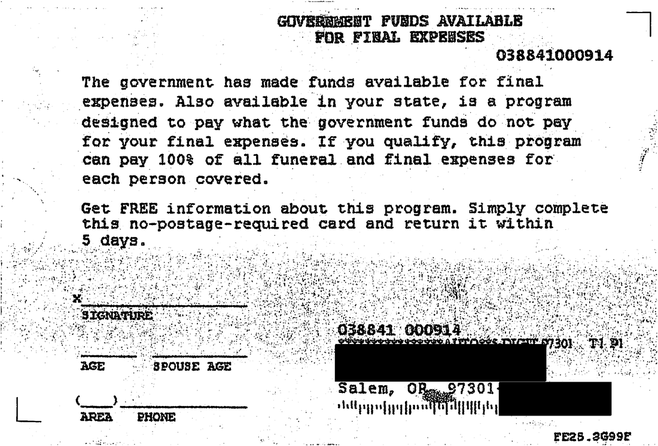
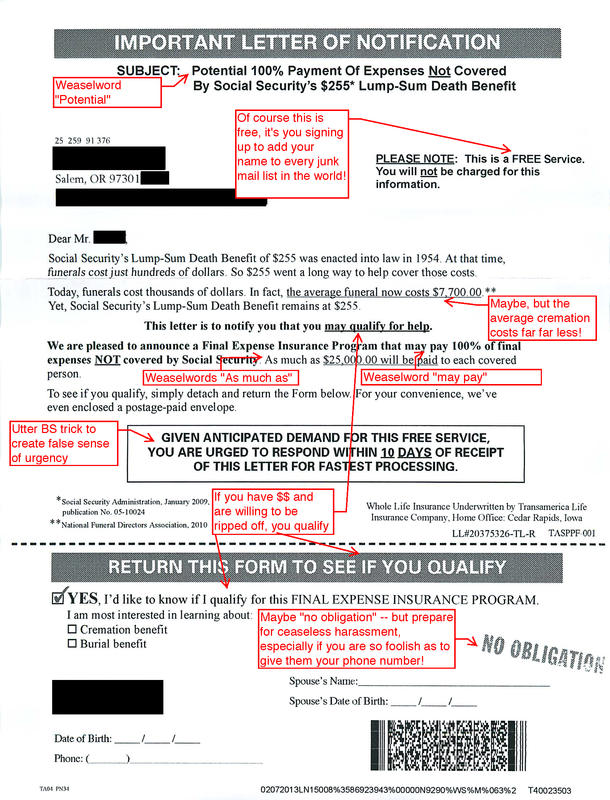
Note the attempts to make it seem to come from a government source The folks who prey on the elderly -- the Elderscammers -- never tire of trying to make their scam letters appear to come from an official source (anything that will get you to open them). When you get mail in an envelope that looks like this, your best bet is probably to recycle it immediately without even opening it.
If you are really torqued about their deceptive technique and want to make it a bit more expensive for them, here's one thing you can do: Open the envelope, but only so that you can find out if there is a postage-prepaid "Business Reply Envelope" inside (there often are). If there is a BRE, take a dark marker and write "STOP SENDING ME JUNK" on the reply card, and draw a big X over the part where they want you to give them all your personal information. Then stuff everything they sent you into the BRE, seal it, and drop it in the mail. This has proven remarkably effective at getting them to stop sending me any such junk. Sadly, all my elderly neighbors and friends keep me well supplied in examples of this kind of scam. (This one was another come-on for funeral expenses insurance, the biggest ripoff this side of waterline insurance plans.)
Mixed in with the many honest businesses, I'm sad to say that there are a TON of ethically challenged businesses out there too. They especially prey on elders, offering them outrageously overpriced goods and services, using all the time-tested tricks of the trade, trying to make it look like they are doing you a favor, and that you might have to "qualify" to do business with them -- when the only qualification is excessive trust in strangers by you, and a willingness to give out private information to total strangers. These people will use any information they can get to take advantage of you (and they will sell and trade that information to similarly exploitation-minded outfits -- along with the key fact, that you were so foolish as to respond to their mailing).
There's a good saying that "Good deals don't call you on the telephone" and the same goes in spades for junk mail like this. Honest businesses don't try to make money off you by selling you wildly overpriced insurance. I wish there was a way to require outfits like this to put a skull-and-crossbones watermark on every page of every letter they send out, because then you'd have a chance of realizing what pirates they are.
(hat tip to "The Housekeeping Report") NCOA Issues Updated Guide for Seniors Considering a Reverse Mortgage The National Council on Aging (NCOA) today issued the 2013 version of Use Your Home to Stay at Home™, the official reverse mortgage consumer booklet approved by the U.S. Department of Housing & Urban Development (HUD). The guide is designed to help seniors understand the pros and cons of a reverse mortgage. Reverse mortgages allow homeowners who are 62 or older to convert home equity into cash while remaining in the home. Amy Ford, director of NCOA’s Reverse Mortgage Counseling Services Network, called the guide “an older homeowner’s best resource when it comes to examining whether a reverse mortgage is right for them.” A free copy of the guide is available (download the pdf by clicking here).
The last time I called one of these things a scam I got a call from a $500 an hour law firm in Virginia who insisted that I remove the post because, no matter how absolutely horrible, no good, outrageously overpriced, predatory, just-this-side-of-illegally-deceptive and slimy their product was, they felt I disparaged them by calling it a scam. So, lesson learned. This may not be a scam -- the company below may indeed pay claims purchased under this absolutely horrible, no good, outrageously overpriced, predatory, just-this-side-of-illegally-deceptive, slimy insurance offer. But you'd be a fool to find out, because you'd have to buy one to find out, and that would mean that you'd not only pay an absurd amount for a tiny benefit, but you'd also find yourself getting a blizzard of mail from similar outfits, because these outfits all trade "sucker lists" as they refer to them, and once you take the bait on one, they all cast their lines in your direction and try to reel you in. Don't fall prey to these kinds of things. If you're concerned about funeral expenses, contact the Funeral Consumer Alliance of Oregon, an affiliate of the national Funeral Consumers Alliance and learn more about how to minimize the costs for disposing of your remains, and how to avoid getting taken. And remember the basic rule: never do business with anyone who tries this kind of deceptive marketing (the attempt to make their commercial pitch appear to be an official letter). The simplest and best thing to do: just recycle it without even opening it.
My elderly neighbor called me today with a question about a man who had approached her while she was raking leaves. He offered to remove the moss from her roof for $150 -- told her he would remove all the moss and leaves, and haul everything away and put an "EPA-Approved" chemical on the roof to keep the moss from coming back. Luckily, my neighbor is getting wily and she had the sense to tell the guy that she needed to check on him -- she called me, and some things she told me about the guy didn't add up, so I looked for a Construction Contractors Board registration, and I found that he was not a registered landscape contractor even though he was going under the name of a landscaping company (which show up under CCB). I also called the Attorney General's Consumer Protection office. More importantly, the guy also shows up in the photo listings of Marion County parole violators.The take-home lesson: NEVER let anyone start working for you, especially on your roof or inside your house, without checking on them first. (You don't want an unlicensed, uninsured person up on your roof, even if they don't intend to rip you off.) Also, never do a handshake deal with a door-to-door service provider; make them give you a written contract showing exactly what they are going to do for you and how much it will cost. If a business is so fly-by-night to not even have contract forms, they are obviously too fly-by-night to hire. (Conversely, don't be fooled by slick brochures and spiffy forms -- just because they have a truck with signs and matching shirts and slick materials doesn't mean that they aren't also crooks.)BOTTOM LINE: Every legitimate service provider -- whether it's a pressure wash of your driveway or removing moss from your roof or washing your windows -- will not object if you say that you want to take their business card and you will call them back if you decide to hire them after you've had a chance to check them out. Anyone who insists that they're only going to be in your neighborhood today, or that their registration is "too new to show up" or that they'll be too busy to come back later is setting you up. Send them packing, and call the Construction Contractors Board and the Attorney General to report them.
Medicare beneficiaries struggling with prescription drug coverage
Five years after the launch of Medicare prescription drug coverage, many beneficiaries are still struggling to sign up, according to a new report from the Medicare Rights Center.
The report highlights how hard it is for beneficiaries to choose among "a multitude of plans that have different benefit structures, pharmacy networks, formularies and rules for accessing benefits." It found that 43 percent of respondents to a recent survey chose to enroll in plans recommended by the Medicare agency's online Plan Finder tool, while 57 percent chose not to.
"This report reinforces what we hear time and again on our helpline," center President Joe Baker said in a statement. "The Part D plan selection process is enough to make many beneficiaries and their loved ones throw up their arms in surrender. People simply want to be able to find and enroll in the drug plan that is right for them, without getting stuck in a morass of indistinguishable plan options."
The report makes four primary recommendations for the Centers for Medicare and Medicaid Services: beneficiaries and their advocates should be able to identify the most comprehensive and affordable plan upon their initial Plan Finder search; the data should be reorganized and a decision tree created to hep guide them; Medicare resources should provide consistent information; and CMS should consolidate plans that lack meaningful differences in order to give beneficiaries access to a manageable number of meaningfully distinct plan choices.
It is remarkable how many people tell me "I need a trust," even though they can't tell me why they need a trust.
Here's a little bit of information on trusts that I prepared for the "Preparing for Departure"(TM) seminar that we're giving right now:
Trusts and Living Trusts
Trusts (and living trusts) are often sold (hard) as an alternative to wills and probate, even for people with modest amounts of property. Despite any hype via the media or that you may hear at an "estate planning seminar," living trusts are not for everyone. It depends on what you own and how you own it, as well as what you intend to happen when you die. Trusts avoid probate (for the property held by the trust only) because the trust, not you, owns the property. In living trusts, you (the grantor) usually set yourself up as both the beneficiary and administrator (the trustee) of the trust, with a successor trustee and successor beneficiaries. While you're alive, you are the business agent of the trust, and you use the trust for your own benefit, such as to pay your bills. If you can’t act as trustee, the successor trustee uses the trust assets for your benefit while you are alive. Then, on your death, the trust assets are used for the benefit of, or turned over to, your successor beneficiaries. Because you did not own the assets solely in your name at your death, they do not need to go through probate.
One downside of trusts is that you need to spend money up front to have the trust created by an attorney and to prepare all the legal documents to change the ownership of your assets (your home, stocks, bank accounts, etc.) to the trust. If you miss something, and you die with assets in your name, a probate may still be required on your death, which is why you still need a pour-over will to "pour" any remaining assets you forgot about into your trust.
The main problem with living trusts is that it's more complex for you to pay taxes, buy and sell things, and just generally to have this separate legal entity in place owning your stuff. It can also just be more expensive.
In fact, in one sense, trusts really don’t avoid probate—they just let you do it yourself while you are still alive, with the extra burden of making sure that every time some circumstance changes in your property or wishes, you do a little bit more probating.
I'm not saying nobody needs a trust. And trusts aren't all bad. I'm just saying that you shouldn't have a trust until you know what problem you are solving by having one, and what the alternatives were, and how much they cost, so that you could compare those alternatives to the care and feeding of the trust.
One reason that some people use them is that they learned about the big, big problems that can result from I call “home brew estate planning,” where people make their someone else a joint owner of their major property, just so that they can "avoid probate." This is often a disastrously bad idea, so if a trust keeps you from doing that, it's a good thing.
For example, if you make your daughter a joint owner with right of survivorship, she can move in with you, she can stop you from selling by refusing to sign off on the deed of sale, and you cannot change your mind and take her off the deed unless she agrees. And if she gets into trouble with debt or legal judgments against her for accidentally injuring someone, you may find yourself co-owning property with someone you never intended.
But you don't need a trust to avoid the home brew estate planning problem. Between Oregon's recently adopted "Transfer on Death Deeds" and a will, you can pretty much do everything you need to do without the bother of a trust.
Be on the lookout for the announcements about the Senior Farm Direct Nutrition Program, or contact your local AAA (Area Agency on Aging). It's an obscenity that many Oregonians, including many elders, don't have enough food every month. It's an even bigger obscenity that the food programs are so underfunded that they have to run a lottery to see which elders get to eat.
But, while this tiny little underfunded program isn't a solution, the faster they are overwhelmed with applicants, the faster policymakers will take note of the need and maybe do something about it.
|