Picture
UPDATE:
In case you missed last night’s premiere of HOT COFFEE, you can still catch this important film.

HBO and HBO2 are re-airing the film several times over the next few weeks (all times Central):

HBO:
  • June 30 (12:30 PM) Central time
  • July 2 (9:00 AM) Central time
  • July 5 (9:30 AM) Central time
  • July 10 (3:00 PM) Central time
  • July 12 (11:30 PM) Central time
HBO2:
  • June 29 (7:00 PM) Central time
  • July 16 (5:10 AM) Central time
  • July 25 (3:55 AM) Central time
  • July 28 (5:30 PM) Central time
"Hot Coffee" is also available on HBO’s on-demand service. And DVD copies of the film will be available in the fall.
==========================
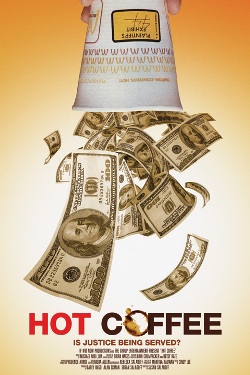
Tune in for the HBO premiere of  Hot Coffee -- a documentary about the fictions and false alarms that threaten the civil justice system.
 
Former Public Justice Foundation President Susan Saladoff produced and directed the film as an article of faith and a labor of love. Years of hard work paid off for her when Hot Coffee was screened at this year's prestigious Sundance Film Festival.  Shortly after that, HBO optioned the film.
 
Hot Coffee is a compelling and provocative documentary that everyone will find enlightening.   For more information about Hot Coffee on HBO, click here.
 
To watch the trailer for the film, click here.  We are proud to claim Susan as one of our own.
 Arthur Bryant, Executive Director
Public Justice and the Public Justice Foundation
email: exd@publicjustice.net   
voice: 202-797-8600
web: http://www.publicjustice.net

 
 
Picture

Scam Alert: Oregon Department of Justice warns of fake FBI emails requesting $350. Here is the link from OregonConsumer.Org for more information.


   I found an old Salem Resources list with a number of useful listings.  As a first step towards updating it, I made a legible version of it (see file below).  Anyone knowing of newer or better information is invited to contact me with the updates so I can update the file.  Please feel free to direct others to this resource list and to suggest additional resources for people in need.
jglo_pdf_4-page_salem_social_services_resource_list_6-2011.pdf
File Size: 125 kb
File Type: pdf
Download File


Picture
   Nonprofits face a Catch-22 when it comes to spending on "overhead."  Lots of services out there like to evaluate (or interrogate under a harsh light) nonprofits for donors based on how much (or, preferably, how little) the nonprofit spends on overhead.
   But starving the overhead function -- the part of the operation concerned with establishing internal policies and procedures, risk management, evaluating past performance, board development, and all the other "back room" functions -- is setting your nonprofit up for long-term failure or serial crises (and then, often, failure). 
    Nonprofits are like farmers --- a good farmer doesn't just put in crops and harvest them.  A good farmer leaves the soil in better condition than before, so that the same land can be used to produce crops year after year.  Nonprofit programs --- the services delivered to the community --- are the crops.  But if you just put all your energy into crop production, the soil is going to get short-changed.  Over time, yield goes down or the inputs required to maintain the yield keeps going up.  Here's a good article by one of the authors of the Oregon Nonprofit Corporation Handbook on this dilemma.


Here's what appears to be a helpful site with information about credit card bills.  One caution about this site though:  don't think that this site (or any other) equips you to do your own credit card debt defense.

  The best thing to do is consult a consumer attorney before you start falling behind on credit card and other bill payments. 
  The next best thing is to consult a consumer attorney as soon as you start falling behind on your bills.
  
   Almost the worst thing you can do is wait until after the card company has filed a lawsuit against you to consult a consumer attorney.
   THE WORST thing you can do is not consult a consumer attorney when you're being sued on a debt and letting the other side win by default.  Every day, creditors and debt collectors file countless lawsuits that have absolutely zero merit.  That is because, every day, collection agencies and creditors sell mountains of bad debts to each other in a massive shell game of "Whack-a-Mole," with each one gambling a few pennies for the chance to try and squeeze dollars out of you on debts that the prior collectors could not collect.  What this means to you is that you might get sued on a debt you never owed, a debt owed by someone else entirely, a debt that is time-barred, a debt that you discharged in a bankruptcy, a debt that they cannot prove to exist, or even a debt that a court already voided before!


Picture
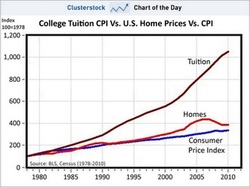
Gary Liberson, Huffington Post - The PEW Research Center looked at the issue of college pricing in their report,"Is College Worth It?" Their findings validate the tensions caused by the high cost of a college education:

A majority of Americans (57 percent) say the higher education system in the United States fails to provide students with good value for the money they and their families spend.

A record share of students are leaving college with a substantial debt burden... a quarter say it has made it harder to buy a home (25 percent); and about a quarter say it has had an impact on their career choices (24 percent).

Nearly every parent surveyed (94 percent) says they expect their child to attend college... most young adults in this country still do not attend a four-year college. The main barrier is financial.

Over the last 18 years, every dollar added to the cost of a college degree has only put 14 cents of annual income in a graduate's pocket.

Bottom line:  No young person should be taking new student loans without being very well advised on the upside and downside risks, which are substantial, and having a well-researched "Plan B" for how to avoid a lifetime of crushing debt obligations if the typical young adult's version of Plan A ("Get in debt up to my eyeballs, graduate, get great job, get out of debt easily") doesn't turn out to work. 


Picture
Great, thoughtful review of an important HBO special here.  I don't even have access to HBO, so I have to go out of my way to find this, but it's worth it.  Although most people put off planning and thinking about end-of-life decisions too long because they think it's depressing, the reality is that most people find that doing the work and thinking about their wishes for end-of-life care and final arrangements is actually uplifting; there's a lightening that you feel when you make your peace with the fact that we're all mortal, and that we will all leave people we care about and stuff we've acquired behind.  Life planning, including plans for what to do if we find ourselves faced with intractable pain, is actually a liberating thing to do.
 
 
  Interesting short article from USAA Magazine includes these points:

   "EVERYONE LOVES A BARGAIN.  But sometimes trying to save money ends up costing more in the long run.  Here are five areas where it's better to skip the discount and save up for high-quality fare."
  The second item listed:

  "ESTATE PLANNING:  For as little as $15, you can buy a do-it-yourself kit for drawing up a will.  However, the USA Educational Foundation points out that estate planning is a complex issue and recommends you update estate planning documents whenever there is a major change in your life or in the tax code.  It might be worth paying an estate planning attorney to make sure you've covered your bases.  Costs vary but generally begin in the $800 to $1,800 range, with more complex documents costing $2,000 and up."

  Now, obviously, I sell estate planning services -- or, as I prefer to think of it and do it, I sell life planning services.  And part of life planning, if only out of courtesy to those left behind, necessarily includes some thinking about what should happen to all your stuff you're going to leave in this world when you depart (known as your estate).  But whether I did life planning or not, I would definitely agree that the people who wind up spending the most on legal bills are invariably the ones who set out to spend the absolute least.  Bottom line, there is nothing more expensive than trying to undo some "home-brew" estate planning that is one part Wikipedia, one part TV shows, and one part a quick discussion with family members.  This really is a case where it's probably better to do nothing than it is to do something wrong while trying to save a little money on legal fees.
 

WORD

06/10/2011

0 Comments


SSI Must be Strengthened
-- by Gerald McIntyre, Directing Attorney, National Senior Citizens Law Center

     The Supplemental Security Income (SSI) program was established to provide critical subsistence income to those older people and people with disabilities who are in greatest economic need.  As Pres. Nixon said on the day he signed the SSI program into law, “For millions of older people, it can mean a big step out of poverty and toward a life of dignity and independence.” Today eight million people rely on this program for survival.  Two out of every three people over the age of 65 who are receiving SSI are women, most often single women.  In order to qualify for SSI, you cannot have more than $2,000 in resources (a home, an automobile and basic household necessities are not counted) and, in most states you cannot have more than $694 in monthly income.  If you qualify, the maximum monthly grant you can receive in most of the country is $674.  For most SSI recipients, that is the only income they have.  For those who do have other income, it is most likely a small Social Security benefit and the SSI grant is reduced to reflect the Social Security benefit.

     Yet even these very modest benefits are at risk in the current budget debate.  For example, if Congress were to enact an across-the-board spending cap, SSI would be severely impacted and the monthly SSI benefit would be reduced from its already inadequate level.  The impact on SSI would be even more severe if, as has been discussed, some major areas of government spending such as defense, Medicare and Social Security were exempt from the cap.  The cuts would soon be reflected in unprecedented levels of homelessness among America’s elderly and disabled population.  A yet worse result might be anticipated from a proposal by the House Republican Policy Committee to dismantle the SSI program and replace it with block grants to the states funded at 2007 funding levels.  Already, without any of the more draconian proposals being adopted, the Social Security Administration (SSA) has seen a decrease in administrative funding at the same time the caseload pressure has been increasing.  Furthermore drastic cuts in administrative funding are threatened.  If these cuts are put into effect, SSA offices will be closed, office staff will be furloughed, already long processing times will be increased and some people will lose access to the program altogether.

     Yes, the SSI program needs changes.  It needs changes to bring it up to date, not changes to return to the time of the Elizabethan Poor Law.  Unfortunately, over the years SSI has been all but forgotten in Washington, except when it comes time to look for ways of saving money.  This emphasis needs to change.  To begin with, the Federal Benefit Rate of $674 needs to be increased.  Also, at present, you cannot have more than $2,000 in resources (not counting your home, automobile or household furnishings) in order to be eligible for SSI.  This amount has increased only 33% since the program was put into law 39 years ago. 

     During that same time, the cost of living has increased over 400%.  The resource limit needs to be increased to $10,000 so that those who are trying to stay in their own homes, can afford to pay for some inevitable and necessary repairs.  Another outmoded provision is one which reduces the maximum federal benefit to $449 a month for someone living in the household of another person.  Often that other person is a relative, also with limited income, who cannot afford to subsidize the SSI recipient.  Finally, as in any program of this size and complexity, it is inevitable that mistakes will be made in determining eligibility or amount of benefits.  The U.S. Constitution requires that there be an effective means of appealing these determinations.  Unfortunately, the appeals system at SSA is a shambles and SSI recipients are left with no effective means of appeal.  The integrity of the appeals process must be restored as part of any SSI modernization. 
 
 
Picture
  I work really hard to use plain English in everything I write.  And it is hard, because so much legal writing is just awful, overcomplicated, junk.  When you swim through so much sludge in your work every day, it's hard not to be affected.  Sometimes I'll be writing and realize that I have inadvertently adopted the same sludgey style as the person I'm responding to.  (Which would be written "Sometimes one observes that one had without intention assumed the characteristics, traits, and significant stylistic markings of the discourse being consumed that was prepared by ones opposite number in the transaction" if you were the average lawyer and didn't want to slit your wrists first committing that kind of sludge.)
   So it's great to get a compliment, and from the other side to a deal to boot!  I drafted a lease for a nonprofit client recently, and the landowner took pains to compliment the drafting.  He wrote that he wished every lawyer wrote so clearly.  That felt great.  Not only did the lease get signed quickly without a lot of back-and-forth about "What does this mean?" but the relationship of the nonprofit to its new landlord is starting out on the right foot, with clear intentions, clearly expressed.


John Gear Law Office LLC; 503-339-7787; John@JohnGearLaw.com. My office is in Suite 208B of the Security Building in downtown Salem. That's at 161 High St. SE, across from the Elsinore Theatre, just a block south of Marion County Courthouse. There is abundant, free, 2-hour on-street parking throughout downtown. #### #### #### Lawyerly fine print: Licensed in Oregon. This site may be considered advertising under Oregon State Bar rules. There is no legal advice given or intended on my site. I'm not your attorney unless we have met in person and entered into a representation agreement; while I hope you will consider me when you seek an attorney, you should not hire any attorney based on brochures, websites, advertising, or other promotional materials.