Picture


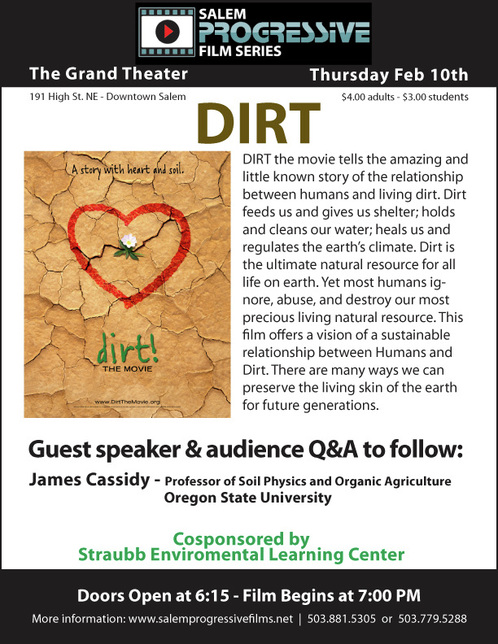
Two Thursdays from now, on February 10, the Salem Progressive Film Series will present "Dirt," a film about the least appreciated part of the three components of the biosphere (Land, Air, Water, or LAW).

John Gear Law Office, LLC, is proud to contribute to the Salem Progressive Film Series so that they can continue bringing provocative, intelligent, and important films to Salem's Historic Grand Theater.
 
 
Bloomberg's Businessweek [sic] magazine has a good article on the student loan debt trap as it plays out at private, for-profit colleges and trade schools.  Choice excerpt:

Students seeking to move up in life by getting a degree from a for-profit college are being trapped in a growing underclass of education debtors. Under U.S. law, their loan obligations can rarely be discharged in bankruptcy, making them more onerous than credit-card debt or subprime mortgages. Defaults can subject students to government confiscation of salaries, tax refunds, and Social Security payments—and disqualify them for aid to get more marketable degrees.

Students at for-profit colleges carry the biggest loans in U.S. higher education. Bachelor's degree recipients at for-profits have median debt of $31,190 compared with $17,040 at private, nonprofit institutions and $7,960 at public colleges, according to Washington-based nonprofit Education Trust.

While currently enrolling one in eight U.S. students, for-profit colleges account for almost one in two federal-loan defaults. The Obama Administration wants to curb rising default rates and the threat of student destitution by cutting off federal funds to for-profit college programs whose students have the worst loan-repayment rates and lowest incomes relative to debt, which suggests their degrees aren't translating into higher salaries. . . .


Forwarded by Kevin Secor, VSO Liaison, Office of the Secretary of the
Department of Veterans Affairs.
    An organization called Veterans Affairs Services (VAS) is providing benefit and general information on VA and gathering personal information on veterans. This organization is not affiliated with VA in any way.
    Websites with the name "vaservices" immediately after the "www" ARE NOT part of the Department of Veterans Affairs, the US Government agency. Do not go to them or if approached or called, do not offer them any information concerning yourself or data on other veterans.
    Keep in mind that the real VA website ends in .gov. Also, be aware that the Department of Veterans Affairs does not randomly call veterans, nor does it ask veterans for information which it does not already have--like Social Security Numbers. In particular, if you have not dealt with the VA previously--and in person--and all of a sudden, you receive a call from someone saying they are with the VA or something similar sounding, hang up the phone. Also, do not respond to emails which suggest that they are from the VA. The VA never conducts official business nor asks for personal information by email.
    VAS may be gaining access to military personnel through their close resemblance to the VA name and seal. Our Legal Counsel has requested that we coordinate with DoD to inform military installations, particularly mobilization sites, of this group and their lack of affiliation or endorsement by VA to provide any services.
    In addition, The General Counsel requests that if you have any examples of VAS acts that violate chapter 59 of Title 38 United States Code, such as VAS employees assisting veterans in the preparation and presentation of claims for benefits, please pass any additional information to Mr.Daugherty at the address below.

        Michael G. Daugherty, Staff Attorney
        Department of Veterans Affairs,
        Office of General Counsel (022G2)
        810 Vermont Avenue, NW, Washington, DC 20420
 
 
  The reality behind the infamous "McDonald's Coffee Case" is that almost everything you hear about it is industrial-strength BS, parroted and amplified by an advertiser-controlled media that is only too happy to repeat simple lies and disinformation rather than delivering a more complex truth that might make some advertisers unhappy.  The greatest part of the Internet is that it lets people like us share information without having to pass through the corporate-owned media's filters.
  Amy Goodman's "Democracy Now" program is a rare oasis of fearless and fierce reporting.  She has a segment on the "coffee case" that ought to be repeated far and wide.
 
 
Picture
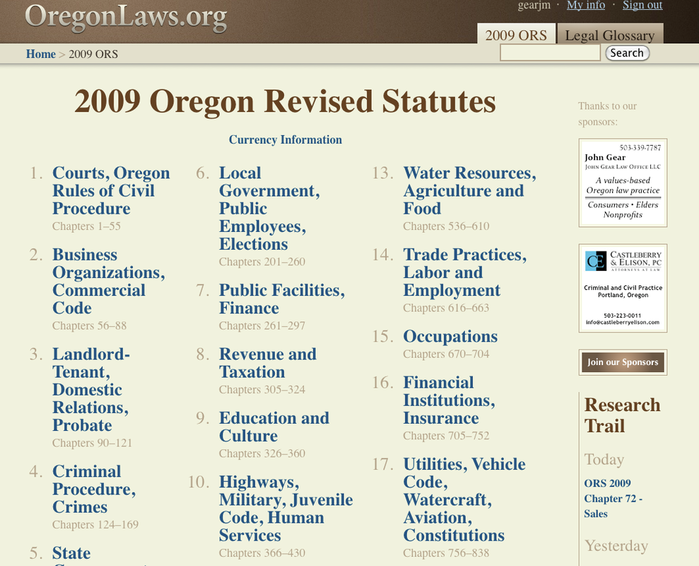
  Attorneys have a variety of databases at their disposal for researching the law.  But what about you, the regular person?  Where can you go to find the Oregon statutes?   Alas, the state website is horrible, because the Legislature ignores everything we've learned about printing and displaying information intelligently since Gutenberg brought movable type printing to the Europe.

  To the rescue comes a law student, Robb Shecter and his partner in making law accessible for the people, Lisa.  They have done an amazing job posting the Oregon Revised Statutes at OregonLaws.org, and presenting them in a thoughtfully formatted way that makes completely and effortlessly readable and usable.  Hats off to them both!

  John Gear Law Office, LLC is very proud to be just the second paid sponsor/supporter of OregonLaws.org.  Sponsorships for  OregonLaws.org help make this site the best way for you to find out just what the law says.
 
 
Lots of interesting material at the Mid-Valley Nonprofit Network's (part of the Nonprofit Association of Oregon) panel discussion on "Board Fundraising:  Lessons from the Field" today.  Here are a few excerpts from notes I made from the discussion by the facilitator and panelists: 
  • "The ask isn't an ask ... It's giving people an opportunity to join you in making something good happen."
  • For most groups, getting better at fundraising and raising the level of board involvement and ownership of fundraising is the single best answer to Steven Covey's "7 Habits" question about "What's the most important thing I could be doing right now?"   Q:  How Does It Happen?  (successful board leadership on fundraising):  A:  (1) Entrepreneurial zeal - you need to be hungry (2) Board commitment; (3) Making sure everyone has passion for the cause.

  • Q:  How do you get board members to be passionate?  A:  You don't ... You can't make others be passionate.  But you can share your passion, such as by sharing stories about the difference you make at board meetings, "putting faces on the spreadsheets."  Also, remember to treat board members like the donors that they are - meaning to include them in any of your volunteer recognition events.

  • BOARD ROLE IN FUNDRAISING:  
  • Not just planning events, but also showing up and participating in them.   Donors expect to see and meet board members at events, participating as hosts.  E.g., board members invite friends to their houses for dinner and drinks ... Then do 45 minutes and a few words from an ED, leave gift envelopes around casually. The board member's story about why they love it is more compelling than the ED's.  Why?  Because the board member isn't paid, and "people give to peers who have given."

  • Successful fundraising doesn't flow directly from emphasizing fundraising, it flows from other key attributes of a successful organization, especially a thought-out board development program, so that you become the kind of nonprofit that has a waiting list of people who want to help.  Every board member has to be a steward for the organization, protect the mission of the group, and represent the group to the world.  (See Marion-Polk Food Share's prospective board member questionnaire.)

  • When you consider a new prospective board member, you must clearly articulate the commitments, including attendance and how much they are expected to raise or give.  If the situation changes, you can ask the member to resign if they can't fulfill their commitment.

  • Q:  What is the role of strategic planning in Fundraising?  A:  For donors, it's a deal breaker if you don't know where you're going.  You have to have your own fiscal house in order, which is what convinces people to give.

  • "Don't talk about what we do, talk about the difference we make."

  • Q:  How do you retain and increase donor support?  A:  Let people know the difference their gift made.  Start with a donor perspective:  why do they give, what do they want from giving.

  • Idea: get the board out of the asking business and into the thanking business.

  • Concentrate on giving donors three to five touches (contacts, calls, letters, events) in between asks, otherwise people start to feel like an ATM for you.
 
 
  The financial world used to tell people not to worry too much about taking out student loans.  The thought was that the money was going for education, which would always pay off.  Kind of like housing prices, which always went up.

  Alas, not so.

  Do you know what you're getting into when you sign up for a student loan?  With a student loan, you can, before you're even able to buy beer legally, radically change the course of your life for decades, dramatically limiting your options for future career and family choices.
  The time to talk to a consumer law attorney about financing your education is before you take out that first loan.  It's not enough to ask your parents or the college's financial aid office.  You need to speak with someone objective, someone who hasn't been seeing you as a future Nobel Prize winner since you were drooling on their shoulder, and someone who doesn't see you as a $100,000 revenue source.

  If you've already taken student loans, you can consult the Student Loan Borrower Assistance website for information about your options and your rights.  (And if you have not yet taken out a student loan, you should still visit the SLBA site, if only to get an idea of the kind of problems that others have run into and to find out what kind of reputation the lender you are thinking of using has.)
 
 
  OregonConsumer.org -- a great resource.
 

John Gear Law Office LLC; 503-339-7787; John@JohnGearLaw.com. My office is in Suite 208B of the Security Building in downtown Salem. That's at 161 High St. SE, across from the Elsinore Theatre, just a block south of Marion County Courthouse. There is abundant, free, 2-hour on-street parking throughout downtown. #### #### #### Lawyerly fine print: Licensed in Oregon. This site may be considered advertising under Oregon State Bar rules. There is no legal advice given or intended on my site. I'm not your attorney unless we have met in person and entered into a representation agreement; while I hope you will consider me when you seek an attorney, you should not hire any attorney based on brochures, websites, advertising, or other promotional materials.